Thermal Inequality
(Ministry of Education)
-
Mr Cai Yinzhou asked the Minister for Education (a) whether the Ministry has identified schools most vulnerable to urban heat island effect; (b) what progress has been made in applying cool paint and installing ventilations across older school campuses; and (c) whether building standards for new schools will mandate passive cooling designs so as to avoid the need for full air-conditioning.
Mr Cai Yinzhou asked the Minister for Education (a) what is the current number of air-conditioned and non-air-conditioned classrooms in schools; (b) whether the Ministry has conducted any studies to elevate the impact of thermal comfort on students' academic performance; and (c) if so, what are the results.
The Minister of State for Education (Ms Jasmin Lau) (for the Minister for Education): As outlined in our reply to Mr Patrick Tay and Mr Kenneth Tiong for the Parliament Sitting on 22 September 2025 and Senior Minister of State David Neo's Committee of Supply speech on 3 March, the Ministry of Education (MOE) aims to provide a conducive learning environment for students, through heat-resilient school design focussed on passive cooling and additional heat mitigation measures.
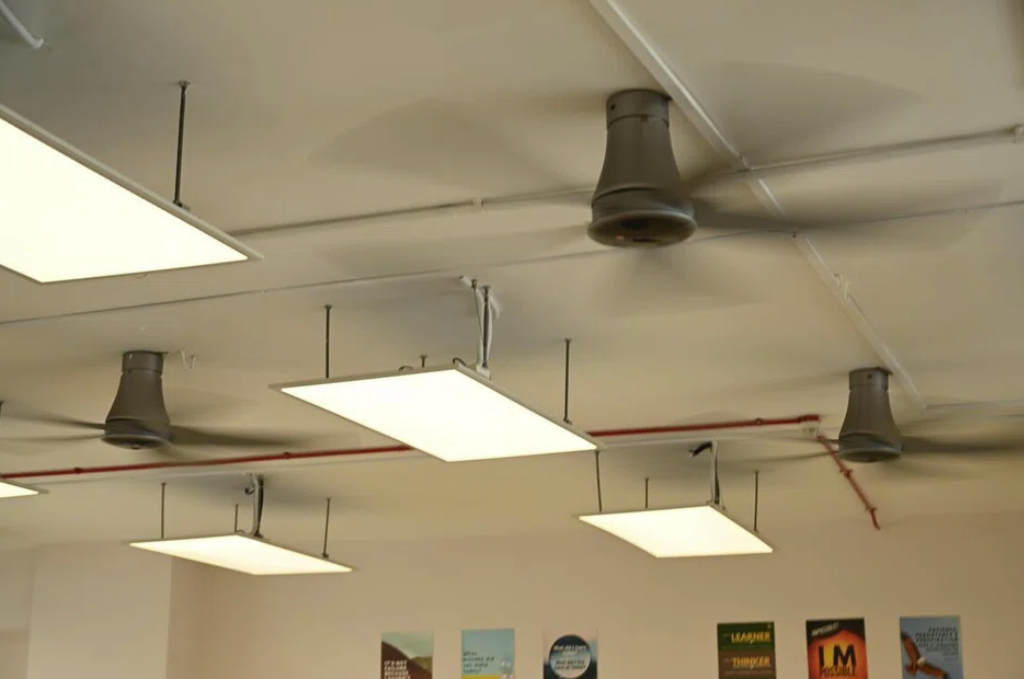
All new schools are designed to achieve Green Mark Platinum Super Low Energy certification, which emphasises passive design to reduce heat gain, reduce reliance on air-conditioning and optimise natural ventilation. For example, school buildings are oriented in a north-south direction for natural cross-ventilation, with shading to minimise direct sunlight and large window openings for enhanced airflow and passive cooling, supported by ceiling fans. Where possible, more shade and greenery are incorporated to further reduce the ambient temperature.
On the additional heat mitigation measures that Mr Cai Yinzhou asked about, these are being implemented progressively. By 2027, all schools will be provided with additional and more powerful fans for classrooms as well as the coating of external building facades with cool paint.
We have also been working with schools to identify those that may experience pervasive heat build-up due to specific site constraints, conditions or surroundings that impede natural wind flow. In cases where the current measures are insufficient, additional cooling measures may be deployed in a targeted manner. Air-conditioning can also be considered for classrooms that need to be enclosed for extended periods due to persistent dust or extreme noise, such as from nearby construction sites.
MOE remains committed to ensuring that all students, regardless of which school they attend, have access to conducive learning environments. MOE is working with other agencies and researchers to study the effects of rising temperatures on student learning and well-being, including gathering more data on local conditions and their effects.
As we gather more evidence on the local impact of rising temperatures on students, we will continue to refine our approach to achieve optimal thermal comfort across all schools in an environmentally sustainable manner. This includes exploring further heat adaptation and active cooling measures for classrooms, such as mixed mode air-conditioning.
Mr Cai Yinzhou (Bishan-Toa Payoh): I thank the Minister of State for her response. I was just wondering further if there are studies on in the impact of thermal comfort on academic performance and with effects, like the urban island heat effect, are there hotter schools than cooler schools, and is there studies on the correlations of academic performance based on that?
Ms Jasmin Lau: I thank the Member for his question. Well, we did have a 2024 National University of Singapore study that identified that cognitive performance does decline above a certain temperature threshold. But this does not mean that all schools may need the same set of cooling measures. We will continue to look across our schools and target the measures at the ones where students may be experiencing more discomfort and this may be temporary or permanent in nature.
Link to Hansard: Link
Image Credit: The Straits Times (Photo: ST Files)