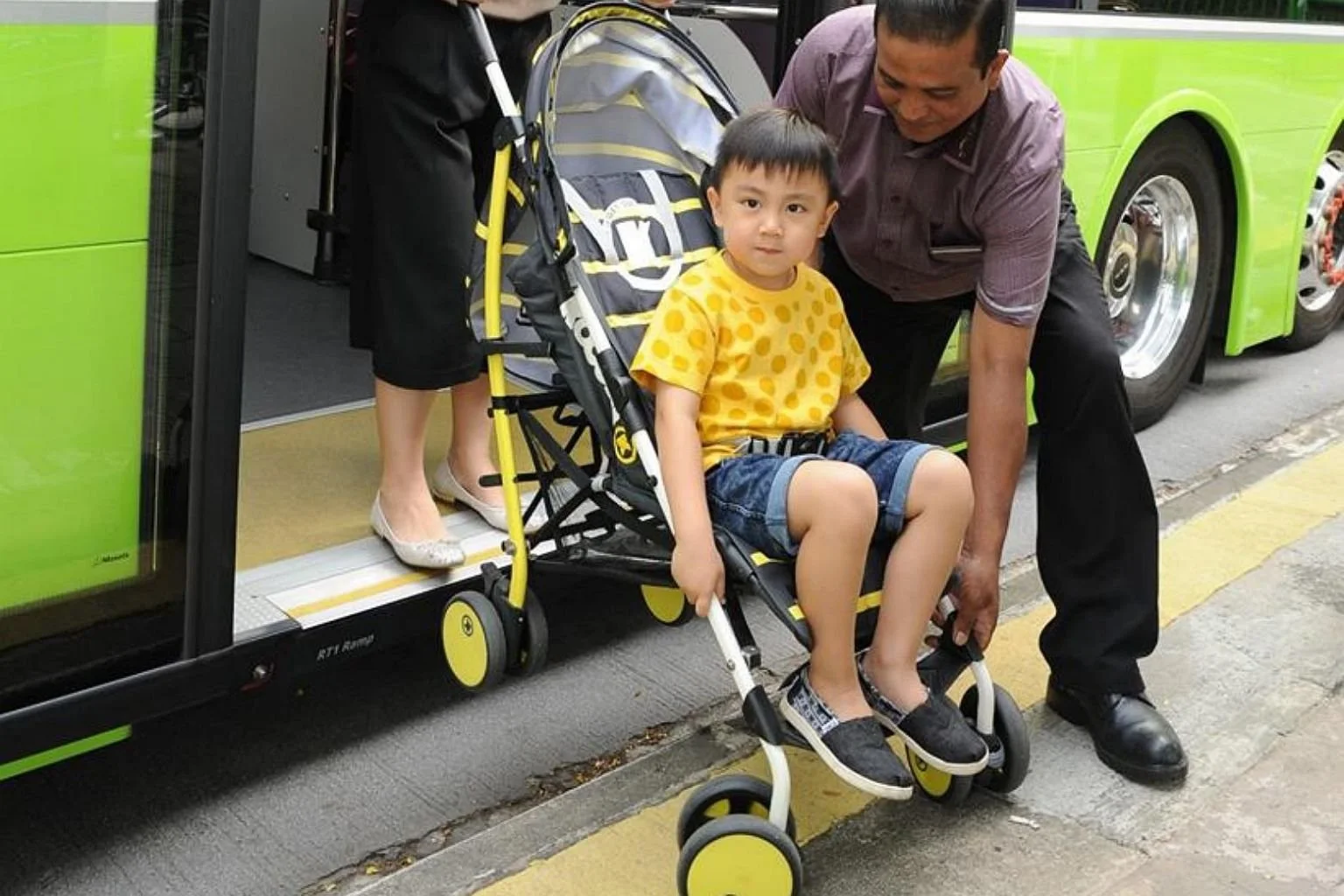
Improving Mobility for Caregivers
(Ministry of Tranport)
-
Mr Cai Yinzhou asked the Acting Minister for Transport (a) whether there are requirements for bus captains to stop within a specified distance from the kerb at bus stops to facilitate boarding and alighting, especially for commuters with strollers; and (b) how many instances of public feedback that LTA has received in the past year from stroller users being unable to board buses due to wide gaps.
Mr Jeffrey Siow: Bus captains are trained to align their buses as close to and as parallel to the bus stop kerbs as possible to facilitate safe boarding and alighting for commuters, including those with strollers. In doing so, bus captains need to take into consideration ground factors, such as whether there are passengers standing near the kerb who risk being hit by the side mirror or the bus.
Out of about 1.4 billion bus trips by commuters in the past year, the Land Transport Authority received less than five pieces of public feedback relating to stroller users having difficulties boarding buses due to wide gaps between the bus and the kerbs. That said, we recognise that not all those who face difficulties will provide feedback. We are exploring ways to help families with young children better access our buses.
Link to Hansard: Link
-
Mr Cai Yinzhou asked the Acting Minister for Transport under the Road Traffic (Quota System – Exemption) Order (a) how many vehicles are currently approved for registration under voluntary welfare organisations; and (b) whether the Ministry will consider including specialised vehicles used by social service agencies to transport vulnerable persons, such as seniors or persons with disabilities.
Mr Jeffrey Siow: As of 18 September 2025, 274 vehicles remain registered under voluntary welfare organisations under the Certificate of Entitlement (COE) Exemption Scheme.
In 2018, the COE Exemption Scheme was replaced with the COE Grant Scheme. The COE Grant Scheme covers the cost of COE and Additional Registration Fee. Eligible social service agencies (SSAs) that need vehicles to transport persons with disabilities or elderly to access key services can apply for the scheme.
Link to Hansard: Link
-
Mr Cai Yinzhou asked the Acting Minister for Transport (a) what manual train or carriage recovery methods has LTA studied to reduce the necessity for mass evacuation of passengers onto the tracks; (b) what specific plans are in place to improve the experience and safety for commuters with mobility aids such as seniors on wheelchairs or parents with strollers during emergency evacuation, especially in underground tunnel segments.
Mr Jeffrey Siow: The evacuation of commuters onto the tracks is a last resort that is only carried out when it is not possible to move a stalled train within a reasonable period of time, or in the event of emergency such as fire or smoke on a stalled train.
Besides the use of rescue trains to move stalled trains so that passengers can disembark at stations, newer trains on the North-South and East-West Lines and the Jurong Region Line are equipped with batteries that enable them to reach the nearest station even when there is no traction power.
During evacuation, operators follow protocols to ensure commuters are evacuated safely. Special attention is given to those with mobility challenges, such as the elderly and people on wheelchairs. Trained officers are deployed to evacuate such passengers. If a train is stalled between stations, Singapore Civil Defence Force personnel are deployed to help evacuate such passengers safely. Train service is only resumed after all passengers are safely evacuated and this is why sometimes train disruptions can take several hours to be resolved.
As part of its work to improve rail reliability and incident response, the Rail Reliability Taskforce formed on 19 September 2025 will look into ways stalled trains can be recovered faster, with a view to further reducing instances where commuters must be evacuated onto the tracks.
Link to Hansard: Link
-
Mr Cai Yinzhou asked the Acting Minister for Transport given that current bus designs limit dedicated space for wheelchairs, strollers or PMAs to only one or two bays, whether the Ministry will consider reviewing the space utilisation of new buses, particularly those on high-demand routes serving polyclinics and senior centres to increase the dedicated multi-functional standing space beyond two bays to accommodate more essential assistive devices for our ageing population.
Mr Jeffrey Siow: The Land Transport Authority ensures that our public transport is inclusive and accessible to all, based on the diverse needs of our commuters. However, given the limited space on board a public bus, we must often make trade-offs in how we use the space.
Adding one more space for wheelchairs, strollers and personal mobility aids would require us to remove at least four seats per bus. This could make it more challenging to accommodate passengers who do not use mobility devices, but need a seat regardless, such as seniors and young children. We will need to study travel patterns and demand, to see if this is the right solution, or if there are suitable alternatives.
Image Credit: The Straits Times (Photo: Land Transport Authority/Facebook)