Project Heart 2025 by Singapore Heart Foundation
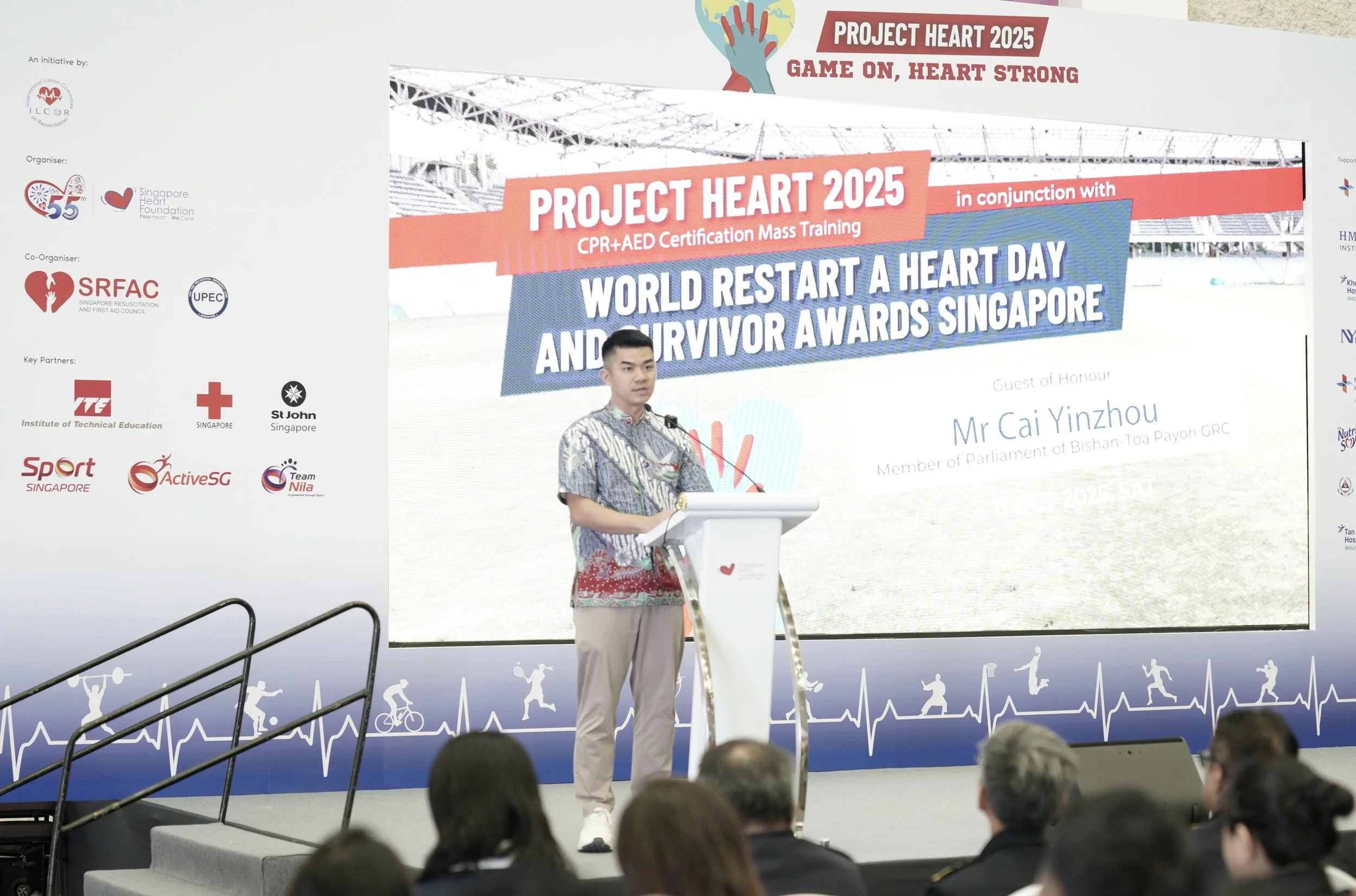
Speech by Cai Yinzhou, Guest of Honour
11 OCTOBER 2025, ITE COLLEGE WEST
Prof Ching Chi Keong, Chairperson of the Heart Safe Committee and Honorary Secretary of the Singapore Heart Foundation
Singapore Heart Foundation Board Members,
Mr Geoffrey Ong, Chief Executive Officer, Singapore Heart Foundation,
Prof Lim Swee Han, Chairperson of Singapore Resuscitation and First Aid Council,
Dr Benjamin Leong, Clinical Director of the Unit for Pre-hospital Emergency Care Committee,
Distinguished Guests,
Good afternoon, everyone. It is a privilege to be here today at Project Heart 2025, one of Singapore's most important community-driven life-saving initiatives. First and foremost, I want to express my sincere gratitude to the Singapore Heart Foundation (SHF) for its steadfast dedication to promoting heart health. Since 1970, SHF has empowered generations of Singaporeans with the knowledge, skills and confidence needed to keep every heart strong and resilient.
I'm also pleased to acknowledge the Foundation's Board Members, our inspiring cardiac arrest survivors and their courageous rescuers, as well as the many partners and participants from the sports and active lifestyle community. Your presence today reflects our collective commitment to preparedness.
"Game On, Heart Strong"
This year's theme, "Game On, Heart Strong", could not be more timely and relevant. We see an increasing number of Singaporeans adopting active lifestyles. While this is a positive trend, it also brings a reality we must acknowledge: medical emergencies can happen to anyone, regardless of age or fitness. We were reminded of this when we lost a 23-year-old man during the 2XU Compression Run in April this year, and in 2023, we lost 15-year-old Pranav Madhaik, a talented student-athlete. These heartbreaking incidents remind us that fitness or youth does not equal immunity. In a cardiac emergency, readiness is what makes the difference.
Project Heart is more than a campaign. It is a call to action for every Singaporean to equip themselves with high-quality CPR and AED skills. It also reinforces the importance of national standards such as the Code of Practice for Sports Safety (SS 681). These are not guidelines for experts alone; they are for all of us. Because in the face of cardiac arrest, preparedness must be universal.
The Power of Being Present
My belief is that readiness comes from personal experience. Growing up in Geylang, I learned to be incredibly aware of my surroundings. It wasn't uncommon to see people passed out on the streets. I'd often watch for the rise and fall of the chest when walking by, making sure they were in a safe position, sometimes even helping them into the recovery position so they wouldn't choke on their tongue.
This gave me a sort of radar for detecting when people needed help, not just physically, but also intuitively. I became attuned to distress, raised voices, or anger.
One of my first encounters with cardiac arrest happened in 2009, while I was organising marathons and mass sporting events. An uncle delivering water suddenly collapsed while pushing his trolley. As my colleague performed CPR, all I could do was hold onto his dentures when they fell out of his mouth. His boss called, and I had to break the news to him.
Since then, I have responded to multiple cases, some involving full CPR rotations with other bystanders before paramedics arrived, others as simple as clearing space in crowded places so the paramedics could move through. Not every case ends in dramatic resuscitation, but every response matters. Whether it is relaying medical history, crowd control or starting compressions, these actions buy critical time.
Emergencies can happen in different forms in our communities. Myresponder app currently provides alerts on rubbish chute fires.
On the mental health front, Singapore will train 1,500 SGSecure Responders in psychological first aid by Apr next year, as part of a national push by MHA to build mental resilience through calm and compassionate support after a crisis.
These situations can happen to anyone, anywhere, and we can all play different roles. Clearing traffic and receiving the ambulance, gathering medical information, and preparing for transfer when the paramedics arrived.
A few seconds shaved could be a life saved, calm, small but deliberate actions—that is what readiness looks like.
That is why I believe strongly in training more Singaporeans. Responding to an emergency is not about being heroic. It is about being human—seeing someone in need and choosing to act.
Building a Prepared Community
Project Heart demonstrates this. Over the years, it has trained thousands of people, from students to working professionals. It has brought together instructors from tertiary institutions, public hospitals, the SAF Medical Corps, Singapore Red Cross, St John Singapore, SportSG and more. With ITE College as a key partner and venue host, this collaborative effort is united by a common goal: To build a confident and prepared community of lifesavers.
And here in Singapore, with our ageing population, the reality is that cardiac arrest could be a stranger today, but a loved one or a family member tomorrow.
This year, we also celebrate the participation of Team Singapore athletes, demonstrating that safety is at the core of sports. They serve as role models for our youth, showing that being prepared is an essential part of true sporting excellence.
Today, we honour the real-life heroes: survivors of cardiac arrest and the everyday Singaporeans who saved them. We will train more hands and hearts through CPR and AED certification sessions. And we will spark awareness in the sporting community, creating ripples of readiness across the country.
Your Next Step
To Singapore Heart Foundation, instructors, partners and volunteers, thank you for your dedication. And to all participants, whether you are learning CPR and AED for the first time or refreshing your skills, it matters that you are here.
I urge each of you to take the next step: a. Cultivate the knowledge and skills in CPR and AED. b. Download and activate the myResponder app. c. Share this knowledge with your teammates, your colleagues and your families.
Who is the one person you are going to commit to training, or encouraging to get trained, this week?
You may never know when you'll be someone's only hope. But when that moment comes, be ready.
Together, let us build a Singapore where no one faces a cardiac emergency alone. Where someone, somewhere, is always ready to step forward.
The power to save a life is already in your hands. Use it.
